Most federal employees understand how to contribute to their TSP.
Very few spend time understanding how withdrawals actually work.
And the withdrawal phase is where mistakes tend to get expensive.
By the time retirement approaches, the Thrift Savings Plan is often one of the largest assets someone owns. Understanding tsp withdrawals and the decisions made in the first few years of distributions can affect taxes, Medicare premiums, and long-term income stability.
If you’d rather watch a walkthrough of this topic, I recorded a full breakdown below.
Below is a written summary of the key points covered in the video, along with additional context that may help you think through your own situation.
How TSP Withdrawals Are Taxed
Traditional TSP withdrawals are taxed as ordinary income.
Every dollar you pull out is added to your taxable income for that year. If withdrawals are large, they can push you into a higher tax bracket. Higher income can also increase Medicare premiums later through IRMAA adjustments.
This is one of the most misunderstood parts of retirement planning.
Penalty-free does not mean tax-free.
Avoiding the 10% early withdrawal penalty is separate from income taxes. Traditional balances are fully taxable at distribution. Roth TSP balances may be tax-free if qualified.
Understanding that distinction alone can prevent costly surprises.
When Can You Withdraw From Your TSP Without Penalty?
There are a few important ages federal employees should know.
The Rule of 55
If you separate from federal service during or after the calendar year you turn 55, you can generally access your TSP without the 10% early withdrawal penalty.
For Special Category employees — such as law enforcement, firefighters, and air traffic controllers — that age is typically 50.
Age 59½
This is the standard penalty-free withdrawal age for most retirement accounts.
Age 73
Required Minimum Distributions (RMDs) begin at age 73 under current law.
Again, avoiding a penalty does not eliminate income taxes. Traditional TSP withdrawals still count as taxable income.
A Common Misunderstanding About the Rule of 55
The Rule of 55 applies specifically to the employer plan you separated from.
If you roll your TSP into an IRA before age 59½, you generally lose that particular penalty exception.
That doesn’t mean a rollover is wrong.
It simply means access rules change. Timing matters.
For someone retiring at 56 or 57 who expects to draw income early, that distinction can make a real difference.
TSP Withdrawal Options at Retirement
There isn’t one universal strategy. There are several ways federal retirees structure withdrawals.
Leave the Funds in the TSP
Many retirees choose to keep their funds inside the TSP due to its low-cost structure and simplicity. You can continue managing allocations and take withdrawals as needed.
Market risk still applies.
Partial or Lump-Sum Withdrawals
You can withdraw part or all of your balance at once. The tax impact depends entirely on how much is withdrawn in a given year.
Large lump sums without planning can create avoidable tax spikes.
Roll Over to an IRA
Rolling over to an IRA can provide expanded investment flexibility and additional income structuring options.
However, as mentioned earlier, rollover timing may affect penalty rules for those under 59½.
Hybrid Approach
In practice, many retirees use a combination:
- Some funds remain in the TSP
- Some are rolled into an IRA
- Some are positioned specifically for income
There isn’t a single right answer. The right approach depends on your income needs, tax situation, and risk tolerance.
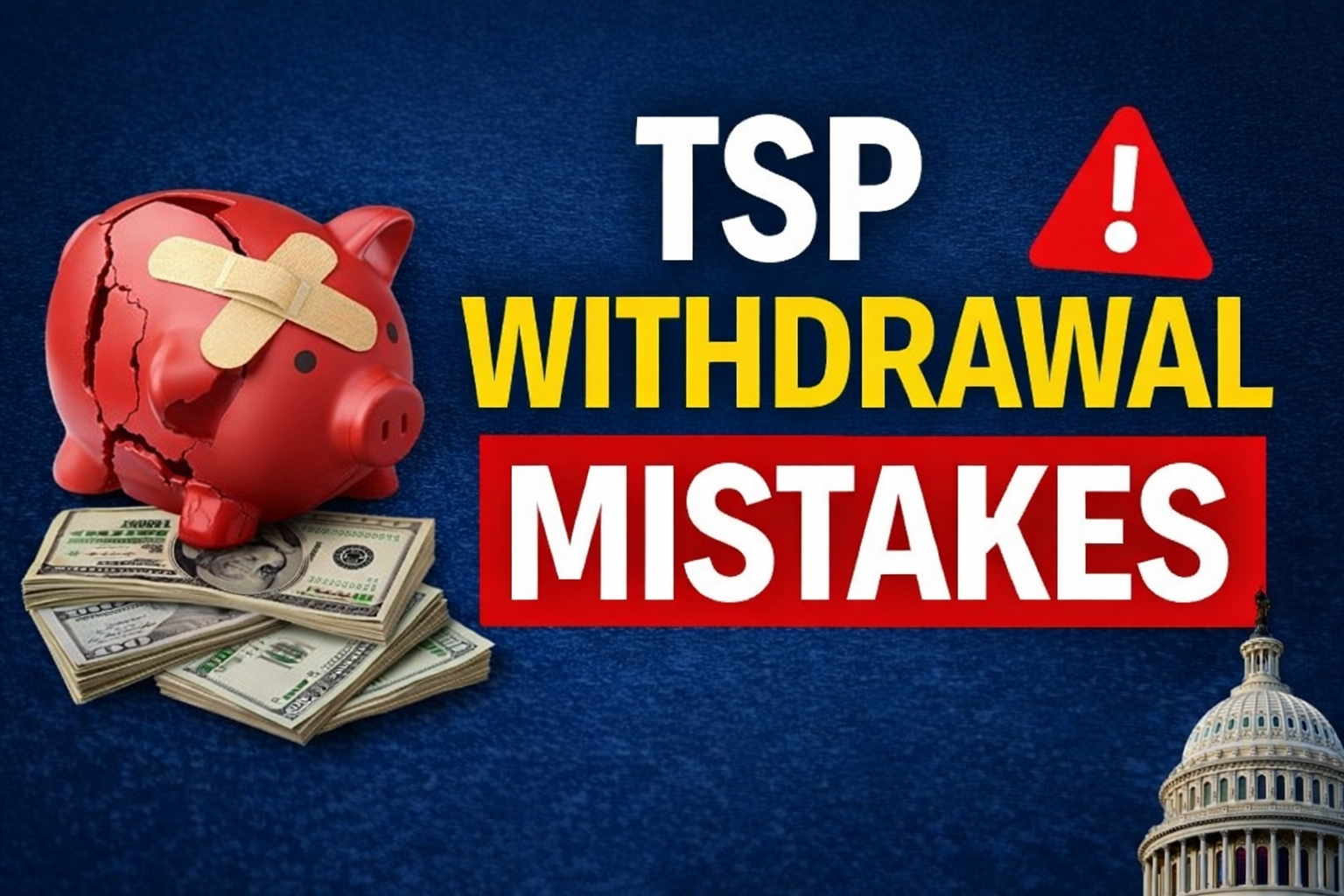
Common TSP Withdrawal Mistakes
A few patterns tend to repeat.
Large withdrawals without tax planning
This often pushes retirees into higher tax brackets unnecessarily.
Failure to coordinate pension, TSP, and Social Security
Retirement income works best when these pieces are aligned intentionally.
Emotional investment decisions near retirement
Moving everything to the G Fund out of fear or staying overly aggressive without considering sequence-of-returns risk.
Withdrawal strategy should be deliberate, not reactive.
Your TSP Is an Asset — Not a Complete Income Plan
Accumulation and distribution are two very different phases.
During your career, the goal is growth.
In retirement, the goal becomes sustainability.
Questions change:
- How long does income need to last?
- What withdrawal rate makes sense?
- How do you reduce long-term tax drag?
- How do you protect against early market downturns?
Those are income planning questions.
And they require coordination between your TSP, your FERS pension, and Social Security. To see how we help Federal Employees plan for Retirement click here!
Final Thoughts
The TSP is one of the most efficient retirement savings vehicles available to federal employees.
But the withdrawal phase deserves just as much attention as the accumulation phase.
Understanding TSP withdrawal rules, tax treatment, and income coordination can help avoid mistakes that are difficult to reverse later.
If you’re approaching retirement and want to review your options, you can schedule a time here: